

Did you know that the first-time pass rate for the Dutch car theory test was just under 39% in 2023? If that figure feels a bit daunting, you’re certainly not alone. Many expats find themselves confused by the three distinct sections of the test or worried that Dutch traffic logic is worlds apart from what they learned back home. It’s a lot to take in, especially when high-quality English study materials feel scattered or hard to find. We understand that the pressure of navigating a new system can be overwhelming, but we’re here to help you bridge that gap.
We believe that with the right mentor, the road to your Dutch license should be exciting rather than exhausting. This guide provides the comprehensive CBR theory exam help English speakers need to master the updated 2026 exam format. You’ll gain a clear understanding of the new animated question styles and access a list of vetted resources specifically designed for international learners. From navigating the DigiD booking process to specific tips for the CBR Utrecht testing center, we’ve gathered everything you need to feel prepared. By the time you finish reading, you will have the clarity and confidence to book your exam and take that first big step toward driving freedom in the Netherlands.
Key Takeaways
- Learn the difference between the standard exam and the extra-time option to choose the best fit for your personal comfort level.
- Discover how to navigate the three pillars of the test, including Hazard Perception, Traffic Rules, and Traffic Insight, to get the CBR theory exam help English students need to pass on their first try.
- Identify high-quality study materials and online platforms that offer at least 2,000 practice questions to ensure you’re ready for the 2026 animated scenarios.
- Master the subtle phrasing traps in English translations, such as distinguishing between what is “wise” and what is “mandatory” under Dutch traffic law.
- Get practical advice for your exam day at CBR Utrecht on Europalaan, including exactly what documents you need to bring to ensure a stress-free experience.
Understanding the CBR Theory Exam in English: Options and Booking
The process of obtaining a licence in the Netherlands starts with a solid plan and a bit of local knowledge. For many expats, the first hurdle is the theory test, which is known for its rigorous standards and specific “Dutch logic.” While the system is demanding, the CBR offers several paths to help you succeed in your own language. When you’re looking for CBR theory exam help English resources, understanding the booking logistics is just as vital as knowing your right of way. You can take the car theory exam in English at any of the 21 CBR locations, but you’ll need to choose between a standard session or a specialized slot with extra time.
English Exam vs. Extra Time Options
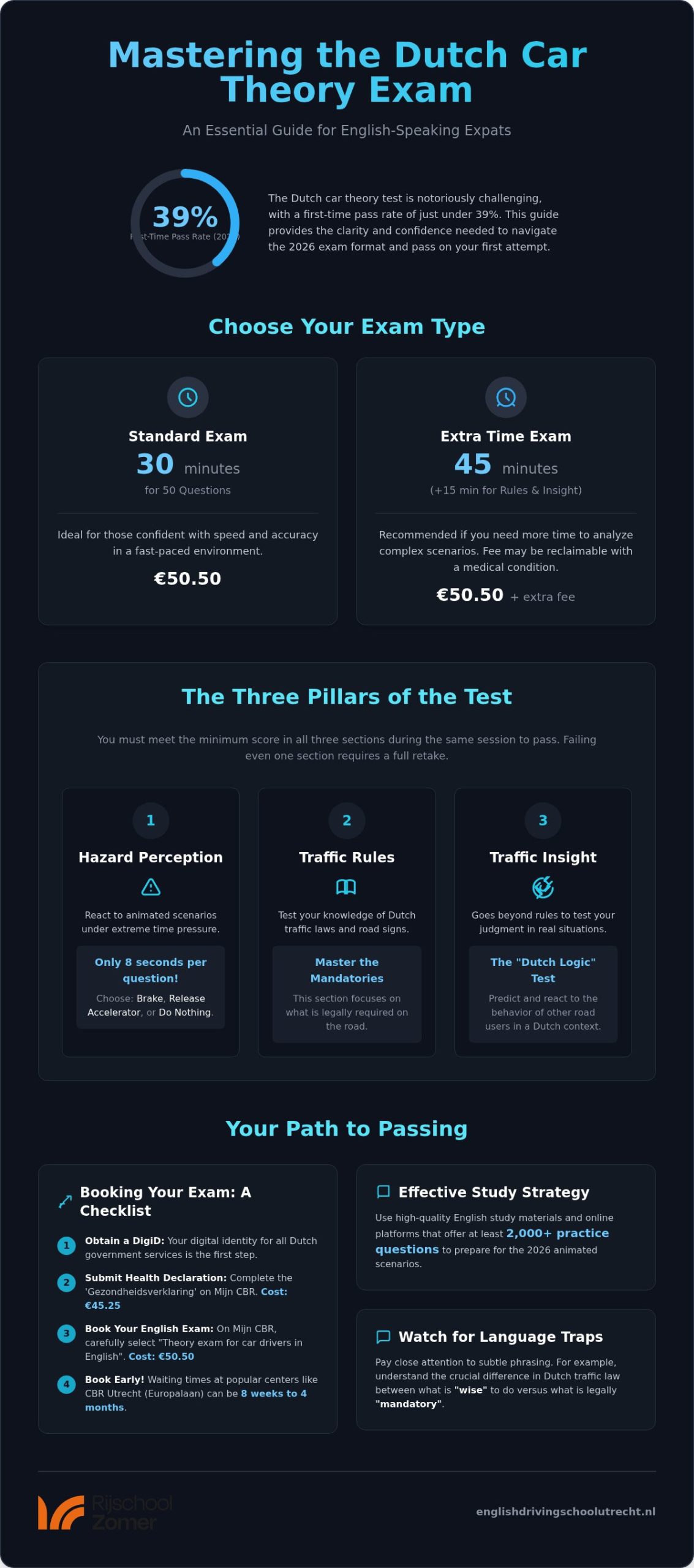
The standard English car theory exam gives you 30 minutes to complete 50 questions. It’s a fast-paced environment where animated clips test your reactions in real time. If the thought of a ticking clock makes your heart race, the “extra time” version might be your best friend. This option grants you an additional 15 minutes, which is primarily added to the traffic rules and insight sections. It’s especially helpful for the insight portion, where you’ll need to analyze complex scenarios carefully. While there’s an additional fee for this extended slot, you can often claim it back if you have a documented medical condition, such as dyslexia.
Booking Your Slot at CBR Utrecht
Booking your exam requires a DigiD, which is your digital identity for Dutch government services. Once you log into the “Mijn CBR” portal, you’ll need to submit a Health Declaration (Gezondheidsverklaring), which currently costs €45.25. Don’t wait until you’ve finished your books to look for a date. At the Europalaan center in Utrecht, waiting times can stretch from 8 weeks to even four months during busy seasons. It’s a popular location, so securing your spot early is a smart move.
When you’re in the portal, be extremely careful to select “Theory exam for car drivers in English” specifically. The fee for this is €50.50. If you accidentally book the Dutch version, you won’t be able to switch languages on the day. If life gets in the way, you can reschedule your appointment through the portal, provided you do it at least a week in advance. For those pursuing a motorcycle or moped license, keep in mind that the CBR doesn’t offer these in English yet. You’ll need to book a Dutch exam and arrange for an official interpreter to join you. Before you book, make sure you’ve reviewed the full CBR exam requirements for expats so you have every document and eligibility detail confirmed in advance. This bespoke approach ensures you get the CBR theory exam help English speakers need to navigate the Dutch roads with confidence.
The Three Pillars of the Dutch Theory Test: What to Expect
Success on the Dutch theory exam requires more than just a good memory; it demands a shift in how you perceive the road. The current 2026 exam format consists of 50 questions that you must complete within 30 minutes. These questions are not just a random mix. They are carefully designed to test three specific areas: hazard perception, traffic rules, and traffic insight. To pass, you must meet the minimum requirements for all three components during the same session. If you fall short in just one area, you’ll need to retake the entire test. This “all-or-nothing” approach is exactly why so many expats look for theory support to ensure they’re prepared for every possible scenario.
As you’ll see on the official CBR website, the exam uses animated video clips to make the experience feel as realistic as possible. This means speed is just as important as accuracy. You won’t have time to second-guess yourself. You need to internalize the “Dutch way” of driving so that your responses become second nature. For many experienced drivers from abroad, the biggest hurdle isn’t the rules themselves, but the “Insight” section, which tests your ability to predict and react to the behavior of others in a characteristically Dutch context.
Hazard Perception: The 8-Second Rule
The hazard perception part of the test is often where students feel the most pressure. You’re presented with a series of traffic situations and given only eight seconds to decide on an action. You must choose between three options: brake, release the accelerator, or do nothing. The CBR looks for a very specific “safe” driving philosophy. For example, if you see a ball roll into the street, the logic isn’t just to watch it; it’s to anticipate a child following it and brake immediately. Mastering this rhythm is a core part of the CBR theory exam help English speakers need to navigate the test successfully.
Traffic Rules vs. Traffic Insight
While “Rules” test sign and law memorization, “Insight” evaluates real-world judgment. It tests your ability to handle complex Utrecht intersections safely, like knowing when not to overtake before a blind curve. This section challenges you to think like a local and prioritize safety over speed every single time.
Essential English Study Resources and Methods
Preparing for the Dutch driving test is a marathon, not a sprint. While the exam format is tough, having the right tools makes a world of difference. When looking for CBR theory exam help English speakers can rely on, start with a 2026 edition theory book. These updated versions include descriptions of the new animated scenarios used in the hazard perception section. Digital platforms are just as essential. You’ll want a database with at least 2,000 practice questions to ensure you aren’t just memorizing specific images, but actually learning the underlying principles. Mobile apps are great for quick reviews on the go, though some free versions suffer from clunky translations that can lead to confusion. Our theory support at English Driving School Utrecht is specifically designed to clear up these linguistic hurdles and provide the clarity you need.
Creating a 4-Week Study Plan
A structured approach helps keep anxiety at bay. We recommend a four-week timeline to fully absorb the material without burning out. This steady rhythm ensures you don’t feel overwhelmed by the sheer volume of Dutch traffic laws.
- Week 1: Focus on memorizing traffic signs and the fundamental rules of priority. This is the foundation for everything else.
- Week 2: Master the Hazard Perception logic. Practice deciding when to brake, release the accelerator, or maintain speed within those critical eight seconds.
- Week 3: Shift to intensive practice exams. This week is all about building the speed required to finish 50 questions in 30 minutes.
- Week 4: Review your mistakes. Focus heavily on the Traffic Insight section, which often requires a more nuanced understanding of “wise” driving.
The Value of Professional Theory Support
Self-study is a great start, but it often leaves gaps that lead to failure for non-native speakers. An instructor acts as a mentor who can explain the “why” behind confusing Dutch road priorities. For instance, why does a cyclist coming from the right have priority in some situations but not others? Understanding these cultural and legal nuances is key to passing. Even better, you can link this knowledge to real-world experience. Booking your first driving lesson in Utrecht allows you to see these rules in action on the streets of Europalaan or the city center. This hands-on reinforcement turns abstract theory into practical confidence, making your study sessions much more effective. By combining high-quality materials with expert guidance, you’ll get the CBR theory exam help English learners need to succeed.
Overcoming the Language Barrier: Nuances and Traps
Taking a high-stakes test is stressful enough without a language barrier standing in your way. While the English version of the test is designed to be accessible, it isn’t always a perfect word-for-word translation. The CBR intentionally leaves certain technical terms in Dutch because those are the words you’ll see on physical road signs and in legal documents. This hybrid approach can be jarring if you aren’t prepared for it. When you’re seeking CBR theory exam help English resources, it’s vital to find guides that don’t just translate the rules but also explain the specific vocabulary the CBR expects you to know.
A Mini-Glossary of Untranslated Dutch Terms
You’ll frequently encounter Dutch terms that describe specific vehicle types or road zones. For example, a “Brommobiel” looks like a tiny car but follows different speed and road access rules than a standard passenger vehicle. You might also see “Voorrangsvoertuig,” which refers to priority vehicles like ambulances or police cars with sirens. Recognizing these terms on sight is non-negotiable. A “Woonerf” is a residential “living street” where pedestrians have priority over the entire road width and motorists must strictly adhere to a walking pace of 15 km/h. If you don’t recognize these words, you’ll likely struggle to answer the associated insight questions correctly.
Phrasing Pitfalls to Avoid
The CBR is famous for its subtle phrasing, which tests your “risk awareness” rather than just your knowledge of the law. You must distinguish between what is mandatory and what is simply a good idea. Questions often ask, “Is it wise to…?” or “Are you allowed to…?” These are two very different things. You might be legally allowed to drive 100 km/h on a specific road, but if there’s heavy rain and poor visibility, the “wise” answer is to slow down. The test uses words like “must,” “may,” and “sensible” to see if you can prioritize safety over technical permission. This is where many non-native English speakers trip up; they focus on the literal rule and miss the situational context.
Dutch driving culture also emphasizes “Social Driving.” This means being predictable and giving other road users space, even if you technically have priority. If you’re struggling to decode these linguistic and cultural traps, our team can help you master the nuances through our specialized theory support. We don’t just teach you the answers; we teach you how to read the questions like a local. This approach is especially helpful for non-native English speakers who need to process information quickly under the 30-minute time limit. Understanding the logic behind test questions keeps you in control during animated CBR scenarios. Combine this with knowing common local driving mistakes to eliminate blind spots before test day.
Exam Day at CBR Utrecht: A Local Guide to Europalaan
The big day has finally arrived. Walking into the CBR center on Europalaan in Utrecht can feel a bit like stepping into a busy airport terminal, but don’t let the clinical atmosphere rattle your nerves. This is the moment where all your study hours and practice sessions come together. To ensure your morning goes smoothly, having the right CBR theory exam help English speakers need includes knowing the physical layout of the building just as well as the traffic rules. You’ve done the hard work; now it’s just about following the local procedure.
The Utrecht CBR Experience
Located at Europalaan 2, the center is easily accessible by car or public transport from the city center. If you’re driving, there’s a dedicated parking lot, though it can get quite crowded during peak morning slots. Once you walk through the main doors, head straight to the self-service check-in terminals. You’ll need your reservation number from your booking confirmation and a valid form of ID, such as your passport or residence permit. Digital copies won’t work here; you must have the physical document. For a complete overview of the exact documents and eligibility criteria you’ll need to bring, consult our detailed guide on CBR exam requirements for expats well before your appointment date.
After checking in, you’ll be directed to the locker area. You aren’t allowed to take anything into the exam room except your ID. This includes your phone, watch, keys, and even your coat. The lockers are free and use a simple four-digit code system. When your number appears on the digital screens in the waiting area, you’ll move to the exam hall. Each station features a modern touchscreen and high-quality noise-cancelling headphones. These are a lifesaver, as they help you stay focused on the animated clips without being distracted by the ambient noise of the room. As soon as you finish, your result appears on the screen, and a detailed score report is sent to your email before you’ve even left the building.
After You Pass (or If You Fail)
Passing the theory test is a massive milestone in your expat journey. Your certificate is valid for 1.5 years (18 months), giving you a comfortable window to complete your practical training. There’s a significant psychological benefit to passing theory before you dive into intensive driving lessons in Utrecht. It means you can focus entirely on car control and the rhythm of the road without constantly second-guessing the meaning of every sign or priority rule you encounter.
If you didn’t make it this time, don’t be discouraged. With a national first-time pass rate of just under 39% in 2023, many students find they need a second attempt to truly master the “Dutch logic” of the exam. You can book a new slot immediately through the “Mijn CBR” portal. Once you have that theory certificate in hand, you’re ready for the final stage: driving exam preparation in Utrecht. We’re here to walk alongside you as you move from the touchscreen to the driver’s seat, ensuring you feel like a confident, capable local on the Dutch roads.
Your Journey to Dutch Driving Freedom Starts Here
You now have the roadmap to navigate the 2026 Dutch theory exam with confidence. Passing the CBR theory exam requires more than book study—it’s about understanding Dutch road rules, hazard perception, and local driving logic.
At English Driving School Utrecht, we offer more than 60 years of local expertise to help you cross the finish line. Our specialised English-speaking instructors provide the personalised coaching you need for high pass rates. Are you ready to move from the theory books to the driver’s seat? Book a Trial Lesson & Get Theory Support in Utrecht today and let’s get you on the road. We’re excited to partner with you and make your Dutch driving goals a reality. You’ve got this!
Frequently Asked Questions
Can I take the Dutch driving theory exam in English?
Yes, you can take the car theory exam in English at all 21 CBR locations across the Netherlands. You simply select the English language option while booking your slot through the official portal. It’s a popular choice for expats, but remember that certain technical terms for road signs will still appear in their original Dutch form to prepare you for real-world driving. This is where getting CBR theory exam help English speakers can rely on becomes invaluable.
How much does the CBR theory exam cost in 2026?
The standard car theory exam in English costs €50.50 per attempt when booked directly through the CBR website. You must also account for the mandatory Health Declaration fee, which is currently €45.25. If you feel you need more breathing room, the version with 15 minutes of extra time carries an additional fee. Booking directly is the most cost-effective way to secure your spot without paying unnecessary third-party administrative charges.
What is the passing score for the CBR theory test?
To pass the exam, you must succeed in all three sections during a single session. You need at least 13 correct answers out of 25 for Hazard Perception; 10 correct out of 12 for Traffic Rules; and 25 correct out of 28 for Traffic Insight. Failing even one section means you’ll have to retake the entire test. This strict requirement highlights why a balanced study plan is so important for international students.
How many questions are in the Hazard Perception section?
There are exactly 25 questions in the Hazard Perception section. For each scenario, you have just eight seconds to decide whether to brake, release the accelerator, or do nothing. It’s a fast-paced part of the test that measures your reactions to potential dangers on the road. Many learners find this the most stressful part, so practicing with 2026 animated clips is the best way to build your confidence and speed.
Do I need a DigiD to book my theory exam?
Yes, a DigiD is essential for booking your exam yourself through the “Mijn CBR” portal. It acts as your official digital identity for all government services in the Netherlands. If you don’t have one yet, it’s wise to apply as soon as possible. The process usually takes a few weeks because your activation code is sent by physical mail to your registered home address. Once active, you can manage your bookings easily.
Is the English theory exam more difficult than the Dutch one?
The core content and difficulty level are exactly the same as the Dutch version. However, the challenge for expats often lies in the specific phrasing and Dutch traffic logic. While the questions are in English, they reflect Dutch road culture, which might differ from your home country. Using high-quality CBR theory exam help English materials ensures you aren’t just translating words, but actually grasping the “Social Driving” principles the CBR expects.
How long is the CBR theory certificate valid for?
Once you pass, your theory certificate remains valid for 1.5 years, or 18 months. You must pass your practical driving test within this timeframe. If the certificate expires before you pass your road exam, you’ll have to retake the theory test from scratch. Most students find this window is plenty of time to complete their driving lessons, but it’s always good to keep an eye on your personal deadline.
Where is the CBR exam center located in Utrecht?
The Utrecht testing center is located at Europalaan 2, 3526 KS Utrecht. It’s a convenient location that’s easy to reach by car or via the local bus and tram networks. When you arrive, you’ll use the self-service terminals to check in with your ID. There are lockers available to store your phone and personal items, as nothing except your identification is allowed inside the exam room itself.