
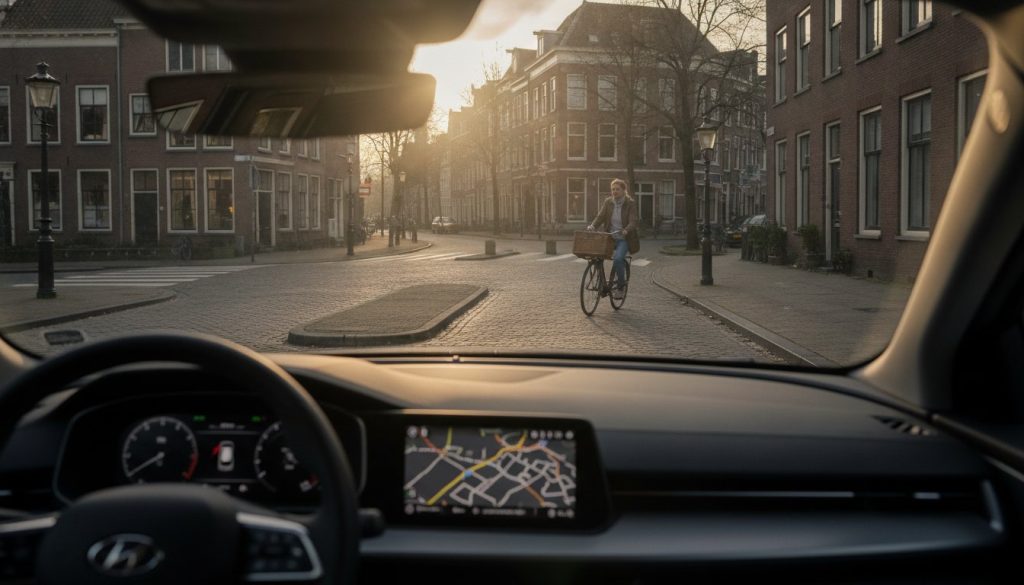
Imagine you’re driving through the Amsterdamsestraatweg; you’ve checked your mirrors, but a cyclist suddenly appears from a “priority from the right” street you didn’t even see. It’s a split-second moment that often leads to an immediate fail. Did you know that in urban hubs like Utrecht, pass rates for the practical exam typically hover between 39% and 48%? It’s a daunting figure for any international resident. Understanding the common mistakes driving test Utrecht examiners look for is often the only thing standing between you and your Dutch license.
We completely understand that navigating the “Dutch way” feels overwhelming, especially when you’re worried about language barriers or those famous, complex bike lane systems. You aren’t alone in feeling that pressure. This guide is here to turn that anxiety into action. We will help you master the specific challenges of the Utrecht CBR exam and show you exactly how to avoid the most frequent errors made by international drivers. You’ll gain local knowledge of exam routes and the confidence to pass as an English speaker. Let’s dive into the specific Utrecht traps and how you can stay one step ahead.
Key Takeaways
- Understand the CBR’s specific focus on “social driving” and what to expect during your appointment at the Europalaan examination center.
- Master the correct observation techniques and priority rules to avoid the common mistakes driving test Utrecht candidates frequently make in 30 km/h zones.
- Learn to navigate local challenges with ease, including the complex multi-lane Europalaan roundabouts and the city’s strictly monitored bus lanes.
- Prepare effectively by using a “Tussentijdse Toets” (TTT) to earn exemptions for special maneuvers and reduce pressure on your actual exam day.
- Overcome language barriers and exam anxiety through personalized coaching tailored specifically for the unique needs of Utrecht’s expat community.
Understanding the CBR Practical Driving Test in Utrecht
The journey to your Dutch driving license usually leads to the CBR center at Europalaan in Utrecht. This busy hub is where your 55-minute practical exam begins and ends. While the process of obtaining a Dutch driving licence can feel clinical, the exam itself is designed to evaluate your safety, independence, and social driving skills. It isn’t just about following rules; it’s about how you interact with other road users in a predictable way. Many candidates focus so much on technical perfection that they overlook the bigger picture, which often leads to the common mistakes driving test Utrecht examiners see daily.
Your test follows a structured timeline. After a brief introduction, you’ll head outside for an eye test, where you must read a license plate from a distance of about 25 meters. The examiner will then ask a few technical questions about the car, such as how to check tire tread or where to find the coolant. Once you’re on the road, about 10 to 15 minutes are dedicated to “independent driving.” You’ll follow a GPS or a series of signs to a specific destination. This section is a frequent stress point for expats, but remember: if you take a wrong turn, don’t panic. As long as you do it safely and legally, you won’t fail for a navigation error.
The Role of the Examiner at Europalaan
It’s helpful to view your examiner as a safety coach rather than a critic. Their main goal is to see if you can drive without intervention. They aren’t looking for a perfect performance; they want to see that you have a “flow” in traffic and that you’re socially responsible. If you’re worried about language, don’t be. Most examiners at the Utrecht center are happy to provide instructions in English to ensure you’re comfortable. Clear communication is key, so feel free to ask for clarification if a direction isn’t clear.
Expat-Specific Challenges in the Dutch System
If you’ve driven for years in another country, you might find the Dutch system surprisingly strict. Overconfidence is a trap. In the Netherlands, “showing” your thoughts is vital. This means using exaggerated head movements during mirror checks to prove you’re observing. Before your big day, it’s a great idea to study the Dutch traffic rules in English to ensure your previous habits don’t conflict with local laws. Mastering these nuances helps you avoid the common mistakes driving test Utrecht candidates often make when they rely too heavily on their home-country driving style.
The 5 Most Frequent Mistakes During the Dutch Driving Exam
Expats often arrive in Utrecht with years of experience behind the wheel. However, this history can be a double-edged sword. You’ve likely developed muscle memory that doesn’t quite align with the rigorous Dutch standards. One of the most common mistakes driving test Utrecht examiners report is the failure to unlearn old habits. It’s not that you lack skill; it’s that you aren’t yet driving the “Dutch way.” Understanding these nuances is the first step toward your license.
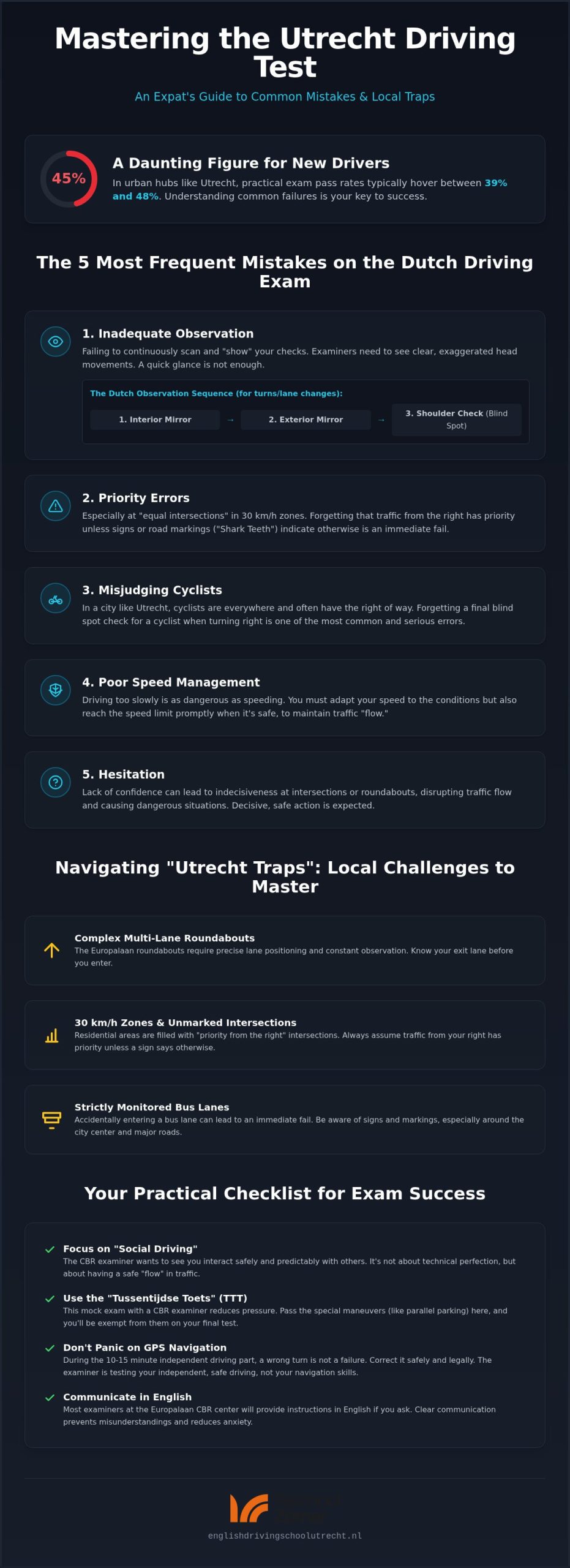
The five most frequent hurdles include inadequate observation, priority errors, misjudging cyclists, poor speed management, and hesitation. Each of these can lead to an intervention by the examiner, which usually means the test is over. Speed management, for instance, requires a delicate balance. Driving too slowly can be just as dangerous as speeding because it obstructs the flow of traffic. You’re expected to reach the speed limit quickly and safely when conditions allow. Let’s break down the two most critical areas where international drivers struggle the most.
Mastering the Dutch Observation Sequence
In many countries, a quick glance in the mirror is sufficient. In the Netherlands, you must follow a strict Interior-Exterior-Shoulder sequence for every lane change or turn. This isn’t just a box-ticking exercise; it is about active scanning. Examiners look for a clear, rhythmic movement of the head. They want to see that you’re searching for potential hazards before they happen. A frequent mistake is forgetting the final blind spot check for cyclists when turning right. In a city like Utrecht, where cyclists often have the right of way, this oversight is an immediate fail.
Priority and the “Equal Intersection” Trap
Utrecht’s residential neighborhoods, particularly those with 30 km/h speed limits, are filled with equal intersections. Unless signs or “Shark Teeth” (haaientanden) white triangles on the road tell you otherwise, traffic coming from the right always has priority. Many international drivers fail because they wait for a stop sign that never appears. On the other hand, stopping to let someone out when you actually have priority is also a mistake. It makes you unpredictable. Predictability is the cornerstone of Dutch road safety, and hesitation can be seen as a lack of confidence or knowledge. If you’re worried about these rules, taking a trial lesson is a great way to see where your current habits might clash with Dutch law.
Navigating “Utrecht Traps”: Local Challenges You Must Master
Every city has its quirks, but Utrecht’s layout is uniquely demanding. The sheer volume of cyclists combined with complex infrastructure creates specific hurdles that can trip up even experienced drivers. One of the common mistakes driving test Utrecht candidates make is failing to adapt to these local “traps” quickly enough. From the moment you leave the CBR at Europalaan, you’re tested on your ability to handle multi-lane roundabouts and strictly enforced bus lanes. These “Lijnbus” markings aren’t suggestions; entering one by mistake is a frequent reason for an immediate fail. You also need to keep a sharp eye out for tram tracks. In the Dutch system, trams almost always have priority, and failing to yield to one is a mistake you won’t get a second chance to correct.
Narrow streets like the Amsterdamsestraatweg present another level of difficulty. These roads are high-activity zones where you must balance your speed with the unpredictable movements of pedestrians and cyclists. It isn’t just about following the speed limit; it’s about driving at a speed that allows you to react to a door opening or a cyclist swerving. This “predictive driving” is exactly what examiners are looking for during your 55-minute window.
Cyclist Safety in the World’s Most Bike-Friendly City
Utrecht is famous for its cycling culture, and the exam reflects this priority. You must understand the difference between a “fietspad” and a “fietsstrook.” A fietspad is separated by a solid line, and you should never enter it with your car. A fietsstrook has a dashed line, meaning you can enter it if you aren’t obstructing a cyclist. When overtaking, aim for a 1.5-meter safety cushion. The most critical maneuver is the right turn across a bike lane. You must check your interior mirror, right mirror, and your right-side blind spot before you even think about turning. Forgetting that shoulder check is a leading cause of failure for international students.
Specific Utrecht Exam Routes and Landmarks
While the exact route is up to the examiner, certain areas are used more frequently than others. Practicing near the Galgenwaard stadium is essential, as its surrounding intersections are common features of the test. You should also prepare for the transition from the high-speed A12 or A2 highways back into the city. Slowing down from 100 km/h to 50 km/h or 30 km/h requires a quick adjustment in your observation rhythm. To get a head start, it’s helpful to review a practice driving exam Utrecht route map. Familiarity with these landmarks reduces your cognitive load, allowing you to focus on your mirrors and the road ahead rather than wondering where the next turn leads.
How to Prepare: A Practical Checklist for Exam Success
Preparation is about more than just hours behind the wheel; it’s about strategy. To avoid the common mistakes driving test Utrecht examiners see, you need a structured plan. Start by making sure you meet all the CBR exam requirements for expats. This includes having your DigiD ready and a valid health declaration. Once the paperwork is sorted, shift your focus to the driving itself. A mock exam with a different instructor can be a game-changer. It simulates the pressure of having a stranger in the passenger seat, which is often where nerves start to interfere with your performance. Don’t forget to revisit your CBR theory exam help notes. Even if you’ve passed the theory test, refreshing your knowledge of priority rules is vital for the practical portion.
The Power of the Tussentijdse Toets (TTT)
The Interim Driving Test (TTT) is a pressure-free trial exam at Europalaan. Performing special maneuvers correctly earns you an official exemption for the final exam, lowering your test-day stress. You’ll receive clear examiner feedback—a perfect roadmap to fix common Utrecht driving mistakes before your real test.
Mental Preparation and Nerve Management
Your instructor is your partner in this journey. They won’t recommend you for the exam until they’re confident you can pass. Trust their judgment. If you feel the pressure building, try “Commentary Driving.” Briefly describe what you see and what you’re doing out loud. For example: “Checking my right mirror for a cyclist… slowing down for the equal intersection.” This technique keeps you focused and proves to the examiner that you’re actively observing. If you make a small mistake, don’t let it spiral. One minor error rarely leads to a fail; it’s the loss of focus afterward that causes problems. Keep driving safely, stay social in your interactions, and maintain your flow. Ready to take the first step toward a stress-free exam? Book a trial lesson today and let’s build your confidence together.
Overcoming Exam Anxiety with English Driving School Utrecht
Feeling a knot in your stomach as your exam date approaches at Europalaan is completely natural. You’re navigating a new city, a new language, and a set of rules that might feel worlds apart from your home country. We don’t just view ourselves as a driving school; we’re your mentors and partners in this journey. Drawing on over 60 years of collective experience, we’ve refined a coaching style that specifically addresses the needs of the international community. We know the common mistakes driving test Utrecht examiners look for because we’ve spent decades helping students successfully navigate them. Our goal is to replace your anxiety with professional confidence.
Every driver is different, which is why we don’t believe in a one-size-fits-all approach. Whether you need to polish your “Dutch Reach” observation or master the timing of equal intersections, our custom lesson packages are designed to target your specific weaknesses. We focus on building a supportive environment where you feel safe to make mistakes and learn from them before the big day. Taking a trial driving lesson Utrecht is the perfect first step. It allows us to give you an honest, professional assessment of your readiness and helps us create a tailored plan that fits your schedule and skill level.
Why English-Speaking Instruction Matters for the Exam
When you’re in the middle of a high-stress maneuver, the last thing you need is a “lost in translation” moment. Our instructors are fluent in English and Spanish, ensuring that every instruction is crystal clear. This clarity is vital when you’re trying to unlearn driving habits from your home country that might not fly in the Netherlands. We understand the specific traffic laws you’re used to and can explain the “why” behind Dutch regulations in a way that actually makes sense. This rapport builds a foundation of trust, making the entire learning process feel encouraging rather than clinical. You’ll go into your test knowing exactly what the examiner expects, with no linguistic guesswork involved.
Your Path to a Dutch License Starts Here
From your very first lesson to the final handshake at the CBR, we guide you through every milestone. We take the mystery out of the process by explaining the logistics, the routes, and the expectations in plain English. If you’re looking for a structured way to reach your goals, our driving lesson packages Utrecht offer the flexibility and depth needed for expat success. Don’t let the fear of the unknown hold you back from the freedom of a Dutch license. Book your trial lesson today, and let’s start building the confidence you need to pass with flying colors.
Take the Wheel with Confidence
Mastering the Dutch roads is a major milestone in your expat journey. By understanding the common mistakes driving test Utrecht examiners look for, from priority rules at equal intersections to the specific “Lijnbus” traps, you’re already ahead of the curve. Success isn’t just about technical skill; it’s about showing the CBR that you are a social, predictable, and safe driver in the heart of Utrecht’s busy streets.
At English Driving School Utrecht, we specialize in turning that pre-exam anxiety into professional readiness. With over 60 years of driving education excellence via Rijschool Zomer, our expert English and Spanish speaking instructors understand the unique hurdles international students face. We’re here to walk alongside you, offering the personalized coaching you need to pass your test the first time.
Are you ready to start your journey? Book your trial driving lesson in Utrecht today! We can’t wait to help you achieve the independence of a Dutch driving license. You’ve got this!
Frequently Asked Questions
What is the most common reason for failing the driving test in Utrecht?
Inadequate observation and failing to give priority are the most frequent reasons for failure. Examiners often see candidates miss a critical blind spot check for a cyclist or hesitate at an equal intersection. These common mistakes driving test Utrecht candidates make are usually due to nerves or old habits. Focusing on a rhythmic scanning sequence and understanding local “priority from the right” rules will significantly improve your chances of success.
Can I take the Dutch practical driving exam in English?
Yes, you can absolutely take your practical exam in English. While the default language is Dutch, examiners at the Utrecht CBR center are accustomed to international residents and are happy to provide directions and feedback in English. It’s important to communicate this preference through your driving school when booking. Having an English-speaking instructor during your lessons ensures you are already familiar with the terminology used during the actual test.
How many driving lessons do expats usually need to pass in the Netherlands?
The number of lessons varies based on your previous experience, but most expats with a foreign license need between 10 and 20 hours to unlearn old habits. If you are a complete beginner, the national average is closer to 43 hours. We recommend starting with a trial lesson to assess your current skill level. This allows us to create a bespoke plan that focuses on your specific needs rather than a generic curriculum.
What should I bring to my CBR practical exam at Europalaan?
You must bring a valid form of identification, such as your passport or residence permit, and your official exam invitation. While your theory certificate is registered digitally in the CBR system, it’s wise to have your passing details accessible on your phone. You don’t need to bring a car, as you will use your instructor’s vehicle. Ensure your health declaration is already approved in the system before you arrive at the Europalaan center.
What happens if I fail my driving test in Utrecht?
If you don’t pass, your examiner will provide a result form detailing exactly where improvements are needed. You’ll sit down for a brief feedback session to discuss your performance. Afterward, you can work with your instructor to target those specific areas. In 2026, the typical waiting time for a re-take in Utrecht is about 5 weeks, so it’s best to book your next attempt as soon as your instructor confirms you’ve corrected the errors.
Is the Utrecht CBR center harder than other locations in the Netherlands?
Utrecht isn’t “harder” in terms of grading, but the urban environment is more complex than rural areas. With pass rates typically between 39% and 48%, the city demands high situational awareness due to its dense cyclist population and narrow streets. Mastering the common mistakes driving test Utrecht candidates face in these busy areas is essential. Success depends more on your preparation for local infrastructure than the specific test center location.
How do I get an exemption for special maneuvers?
You can earn an exemption for special maneuvers by passing the Tussentijdse Toets (TTT), also known as the interim test. If you perform maneuvers like hill starts or reverse parking successfully during this mock exam with a CBR examiner, you won’t have to do them during your actual practical test. This is a fantastic way to reduce stress and focus entirely on your traffic participation and safety during the final exam.
Are Utrecht examiners more strict with international drivers?
No, CBR examiners follow a standardized national rubric that applies to every candidate regardless of their background. They focus purely on whether you can drive safely, socially, and independently. Any perceived strictness usually stems from the high standard of observation required in the Netherlands, which can feel intense if you’re used to different rules. Our instructors help you bridge this gap by focusing on the specific “Dutch way” of driving.