
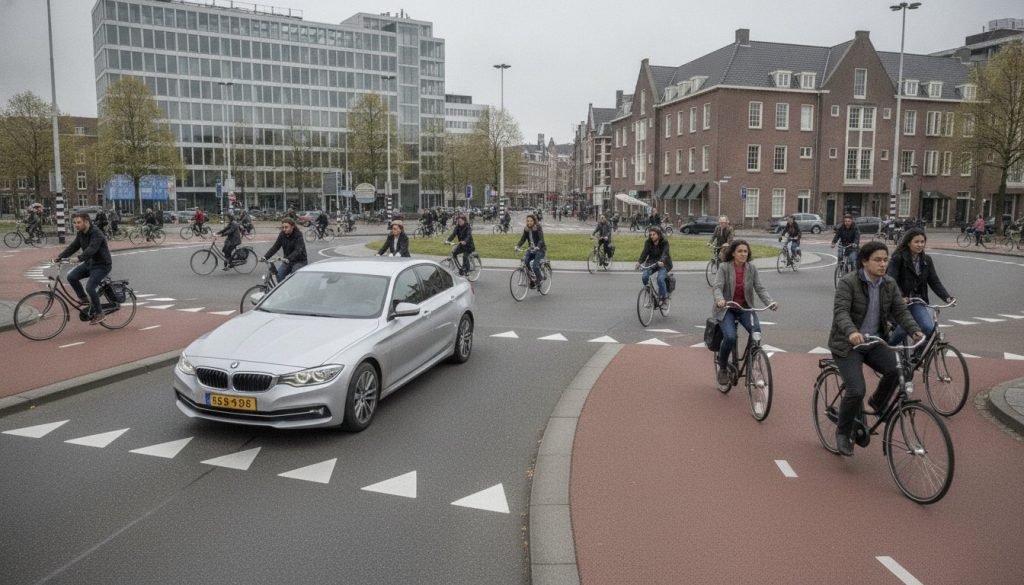
Key Takeaways
-
CBR Examination Location Accuracy: The official CBR practical exam center in Utrecht is located at Mississippidreef 151 (Overvecht), not Europalaan.
-
Master Complex Roundabouts: Navigating multi-lane and turbo roundabouts (like Berekuil and 24-Oktoberplein) requires early lane selection and continuous blind-spot checks for fast-moving e-bikes.
-
Cycle Awareness & Fietsstraaten: On red-asphalt bicycle streets marked “Auto te gast”, motor vehicles are guests; overtaking cyclists is strictly prohibited.
-
Decode Road Markings: White triangular haaientanden (shark teeth) dictate right-of-way, while unmarked residential intersections strictly enforce mandatory priority from the right.
-
Bilingual WRM Instruction: Practice actual Utrecht exam routes with WRM-certified instructors in English, Spanish, or Dutch without long waiting lists.
Table of Contents
-
The Anatomy of a ‘Tricky’ Utrecht Intersection
-
Navigating Utrecht’s Most Challenging Roundabouts
-
The Cyclist Factor: Inner-City Junctions and Lombok
-
Decoding Road Markings: Shark Teeth and Priority Signs
-
Mastering Utrecht’s Streets with Zomer Verkeersopleidingen
The Anatomy of a ‘Tricky’ Utrecht Intersection
+-------------------------------------------------------+
| CBR UTRECHT EXAM OVERVIEW (2026)                      |
+-------------------------------------------------------+
| Practical Test Address | Mississippidreef 151         |
| Public Transport Stop  | Franciscusdreef (Bus 9 / 28) |
| English Theory Fee     | €57.00                       |
| Health Declaration     | €46.90                       |
| Base Practical Fee     | €143.50                      |
+-------------------------------------------------------+
Navigating Utrecht’s Most Challenging Roundabouts
-
Spiral & Turbo Lane Logic: Choose your target lane before entering the roundabout. Spiral lanes naturally guide your vehicle outward toward your designated exit.
-
Exit Blinking: Signal right immediately after passing the exit prior to yours.
-
Cyclist Priority: On urban roundabouts, exiting vehicles must yield to cyclists riding along the outer ring. Always check your right blind spot over your shoulder before crossing a bike path.
The Cyclist Factor: Inner-City Junctions and Lombok
-
Tegelijk Groen (All-Directions Green): When traffic lights signal green for all cyclists simultaneously, drivers turning right must wait for the entire intersection to clear.
-
E-Bike Speed Differentials: E-bikes approaching at 25–45 km/h require deeper scanning distance than conventional bicycles.
-
The Dutch Reach: Always open your driver door with your far (right) hand to naturally rotate your body and check for approaching cyclists.
Decoding Road Markings: Shark Teeth and Priority Signs
+-------------------------------------------------------+
| UTRECHT TRAFFIC MARKINGS & PRIORITY                   |
+-------------------------------------------------------+
| Shark Teeth (Haaientanden) | Must yield to crossing   |
|                            | traffic/cyclists         |
| Unmarked Intersections     | Yield to ALL traffic     |
|                            | approaching from right   |
| Yellow Diamond Sign        | Priority road status     |
+-------------------------------------------------------+
Mastering Utrecht’s Streets with Zomer Verkeersopleidingen
-
No Waiting Lists: Practical double lessons (50-minute sessions) can start immediately.
-
Bilingual WRM Instructors: Professional instruction available in English, Spanish, and Dutch.
-
Flexible Pickups: Pickups available directly at Utrecht Central Station, home, or office locations.
-
Modern Fleet: Practical lessons are conducted in a white Volkswagen Golf 8, available in both manual and automatic options.
Decoding Road Markings: Shark Teeth and Priority Signs
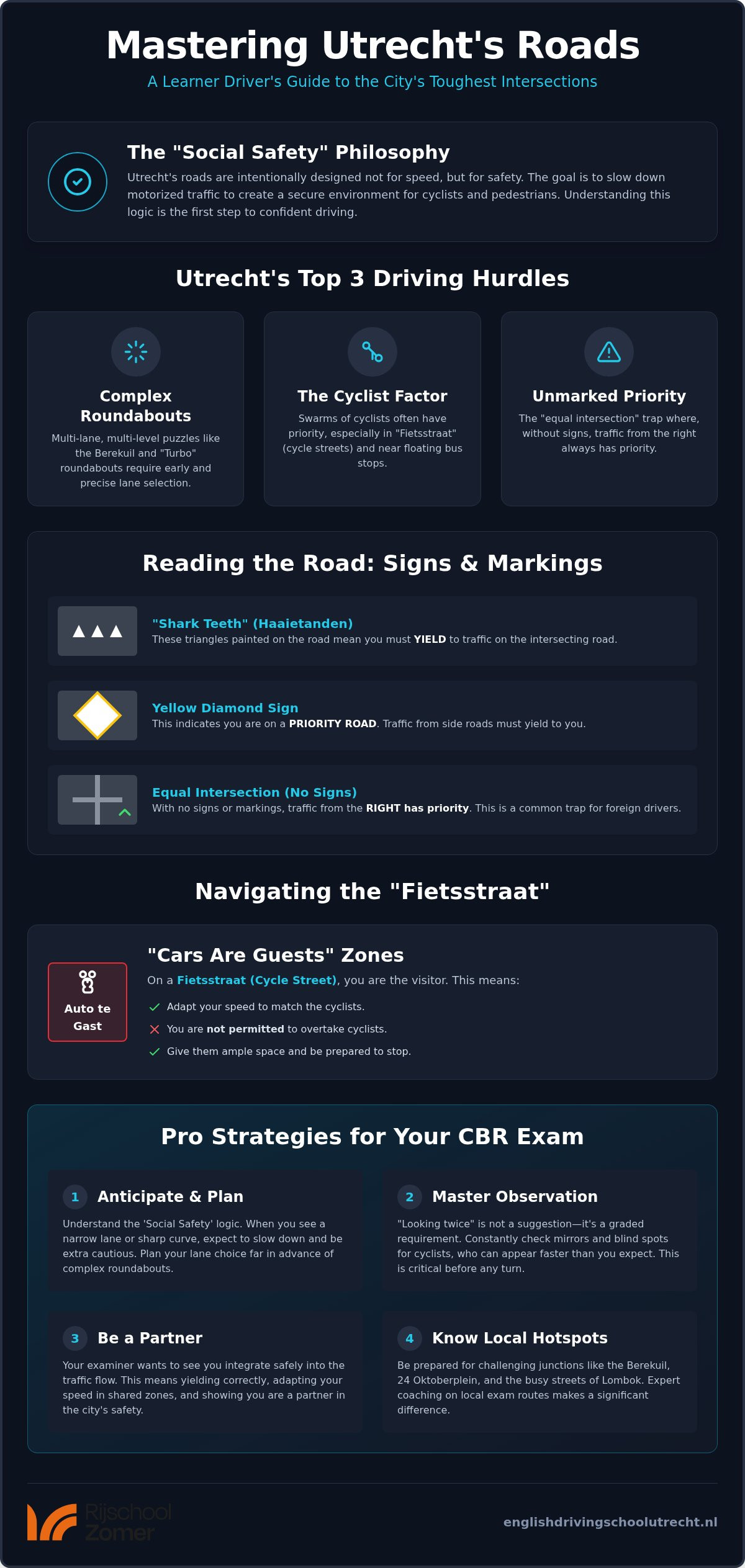
Road markings in the Netherlands are more than just paint; they’re a silent language that tells you exactly who should move first. For many expats, the most dangerous part of navigating tricky intersections in Utrecht for learner drivers is the “Equal Intersection” trap. If you don’t see any signs, triangles, or teeth at a junction, the rule is absolute: traffic from the right has priority. It doesn’t matter if you’re on what looks like a wider road; if someone pulls out from a tiny street on your right, you must let them go. This is a frequent point of confusion in 30 km/h residential zones, which now cover approximately 270 streets across the city as of July 2026.
You also need to distinguish between mandatory bike lanes, marked by solid white lines and a bike symbol, and advisory lanes with dashed lines. You’re allowed to drive on an advisory lane if necessary, but you must never hinder a cyclist. Contrast this with the “Voorrangsweg” or priority road, identified by a yellow diamond sign. When you see this, you have the right of way at upcoming intersections. However, always look for “Shark Teeth” (haaientanden) on the ground. These white triangles pointing toward you are the ultimate visual cue that you must give way. Understanding these markings is essential for your Dutch driving test for foreign license holders, as misinterpreting priority is a common reason for an immediate fail.
Priority Signs vs. Road Markings
What happens if a traffic sign seems to say one thing while the road markings say another? In the Dutch hierarchy, vertical signs on poles generally carry more weight than markings on the pavement. Of course, both are superseded by traffic lights or a police officer’s instructions. A critical rule to remember in Utrecht is the “Stop” sign. Unlike some countries where a “rolling stop” is common, here it’s an automatic CBR fail. Your wheels must come to a complete, visible standstill before the line, even if the road looks empty.
Shark Teeth Scenarios
When you approach a junction with shark teeth, your preparation should start early. Even if there’s no approaching traffic, you should slow down and show the examiner you’ve recognized the requirement to yield. Shark teeth differ from stop lines because you aren’t required to stop if the way is clear, but you must be ready to do so. In the new 30 km/h zones, these markings help clarify priority where the “right-hand rule” might otherwise feel ambiguous. If you want to master these visual cues in a real-world setting, our Individual Driving Lessons provide the hands-on practice you need to feel at home on Utrecht’s streets.
Mastering Utrecht’s Streets with Professional Coaching
You’ve studied the hierarchy and memorized the road markings, but how do you feel when you’re actually behind the wheel at a busy junction? Reading about Dutch traffic rules in English is a fantastic foundation. However, theory alone can’t prepare you for the split-second decisions required at tricky intersections in Utrecht for learner drivers. Real-world experience is where the pieces of the puzzle finally click together. A professional instructor acts as your mentor, helping you translate those textbook rules into smooth, safe driving habits that become second nature.
Our approach focuses on identifying your personal “blind spots” before they become a problem during your exam. Perhaps you’re comfortable with roundabouts but struggle to anticipate the speed of e-bikes in the Lombok district. Or maybe you find the multi-lane complexity of the 24 Oktoberplein intimidating. We use mock exams on real CBR routes in Utrecht to simulate the pressure of the practical test. This targeted practice ensures that by the time you meet your examiner, you aren’t just guessing; you’re driving with genuine authority and calm.
The Value of a Trial Lesson
Every expat brings a unique driving background to the table. Some are seasoned drivers from countries with different priority rules, while others are starting from scratch. A trial lesson is the perfect way to assess your current skill level within the context of Dutch traffic logic. You’ll get immediate, supportive feedback on your intersection management and observation techniques. It’s an easy, low-pressure way to see exactly what you need to master. If you’re wondering where to start, our guide on how to get a Dutch driving license walks you through the entire process from start to finish.
Your Journey to a Dutch License
We understand that driving in a new country can cause a lot of road anxiety. That’s why our English and Spanish-speaking instructors at English Driving School Utrecht focus on building a partnership with you. We offer the most reliable coaching in the region, backed by extensive experience and a deep understanding of local traffic. Our custom lesson packages are designed to build your confidence layer by layer. We won’t throw you into the busiest tricky intersections in Utrecht for learner drivers until you’re ready. We’re here to walk alongside you throughout your journey, ensuring you feel empowered to pass on your first attempt. Ready to take the first step toward your freedom on the road? Book Your Trial Driving Lesson in Utrecht Today and experience the difference of local expertise.
Ready to Conquer the Road?
Navigating the complex web of Utrecht’s streets doesn’t have to be a source of stress. By understanding the “Social Safety” logic and mastering the specific patterns of the Berekuil and Lombok, you’ve already taken a huge step toward your Dutch license. We’ve seen how identifying tricky intersections in Utrecht for learner drivers is about more than just memorizing signs. It’s about developing a keen eye for cyclists and a calm approach to multi-lane roundabouts.
With 60+ years of local expertise through our parent company, Rijschool Zomer, we specialize in helping the international community succeed. Our English and Spanish-speaking instructors are dedicated to your progress, contributing to our high pass rates for Utrecht expats. You don’t have to face these challenges alone. We’re here to walk alongside you, providing the tailored coaching you need to feel completely at home behind the wheel.
Ready to turn your anxiety into confidence? Master Utrecht’s tricky intersections with a Trial Lesson and start your journey toward a first-time pass today. You’ve got this, and we can’t wait to help you get there.
Frequently Asked Questions
What is the most difficult intersection in Utrecht for the driving exam?
Many candidates find the Berekuil multi-level roundabout to be the most challenging spot. It requires precise lane selection before you even enter and constant vigilance for cyclists on the outer ring. Because it connects major routes like the A27 to the city centre, the traffic volume is high. Mastering this spot is a key part of navigating tricky intersections in Utrecht for learner drivers, as it tests your ability to spiral outward correctly.
Do cyclists always have priority at roundabouts in Utrecht?
No, cyclists don’t always have priority, though it often feels that way. Priority depends on the specific design of the roundabout and the presence of “shark teeth” markings. On many urban roundabouts in Utrecht, cyclists on the circular path have the right of way over exiting or entering cars. Always look for the triangular markings on the ground; if they point toward you, you must yield to the cyclists crossing your path.
What are ‘shark teeth’ on Dutch roads and how do they work?
‘Shark teeth’ (haaientanden) are white triangular markings painted on the road surface that indicate you must give way to traffic on the crossing road. They function as a yield sign, meaning you don’t necessarily have to stop if the road is clear, but you must be prepared to. They are a fundamental feature of tricky intersections in Utrecht for learner drivers, often appearing at the entrance to roundabouts or bike paths.
How do I handle an intersection with no traffic signs or lights?
At an “equal intersection” with no signs, lights, or markings, you must give priority to all traffic coming from your right. This is a strictly enforced rule in the Netherlands, especially in the 30 km/h residential zones that now cover 270 streets in Utrecht. Even if you’re on a wider road, a cyclist or car emerging from a small side street on your right has the right of way. Slow down early.
What is the ‘all-directions green’ light for cyclists in Utrecht?
The ‘all-directions green’ (Tegelijk Groen) system allows cyclists from every direction to enter an intersection at the same time. While this keeps bike traffic moving, it means car drivers turning right must be exceptionally careful. You’ll see a swarm of cyclists crossing your path simultaneously. You must wait patiently for the entire group to clear before you proceed with your turn, even if your own traffic light is green.
Can I fail my CBR exam for not looking at a bike lane when turning right?
Yes, failing to check your mirrors and blind spot for a bike lane is a very common reason for an automatic fail. In the Netherlands, traffic going straight on the same road has priority over turning traffic. This includes cyclists in the lane to your right. You must perform a physical shoulder check every single time you turn to ensure no one is “undertaking” your car from the blind spot.
How do I identify a priority road in the city centre?
You can identify a priority road (Voorrangsweg) by looking for a yellow diamond-shaped sign. When you’re on this road, you generally have priority at upcoming intersections. However, keep in mind that many streets in the historic city centre are now 30 km/h zones where the “priority from the right” rule often applies instead. Always keep an eye out for the end-of-priority signs, which feature a grey diamond with black lines.
Are there specific rules for driving near Utrecht Central Station?
Driving near the station requires extreme focus due to the mix of buses, trams, and thousands of pedestrians. Trams almost always have priority unless signals indicate otherwise. The area around Westplein and the station is redesigned to prioritize “vulnerable users,” so expect many “cars are guests” zones. By 2026, new freight regulations and weight limits also apply, making it vital to stay in your designated lane and follow all electronic signage.